Showing posts with label undergraduate research. Show all posts

Wednesday, February 7, 2024

130 years of mind games and quantum challenges

 A wonderful article by Laurie Wurth-Pressel (source)

130 years of mind games and quantum challenges
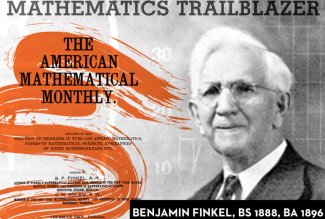
graphic showing Benjamin Finkel, a mathematic trailblazer

2024 marks the 130th anniversary of The American Mathematical Monthly. 

The trailblazer who launched this premier academic journal in 1894 and inspired the establishment of the American Mathematical Association (AMA) graduated from Ohio Northern University in the late 1800s—Benjamin Franklin Finkel, BS 1888, BA 1896.

Mathematical problems fascinated Finkel from a young age, and his eagerness to solve them impelled his ambition to “publish a journal devoted solely to mathematics and suitable to the needs of teachers of mathematics.”

He once stated: “Many dormant minds have been aroused into activity through the mastery of a single problem.” 

Over a century later, Finkel’s statement still rings true. 

While much has changed at Ohio Northern since Finkel’s days, the University continues to attract brilliant problem-solvers molded in Finkel’s character who graduate to become leading mathematicians and physicists. 

Read about three outstanding alumni from ONU’s School of Science, Technology, and Mathematics, housed in the Getty College of Arts & Sciences, who are making a mark in the world of physics and mathematics.

Tommy) Steinberger: From algebra to plasma physics

Thomas (Tommy) Steinberger, BS ’14, Ph.D., is breaking new ground in experimental plasma physics at West Virginia University in Morgantown, W.V.

A research assistant professor in the Department of Physics and Astronomy, he explores charged gas systems (plasmas), investigating gas particle motion and temperature. His work aims to enhance electronics manufacturing, space travel, and our understanding of space phenomena, such as magnetic reconnection.

“I come into the lab and can work on 10 different projects before lunch,” he said. “I have a lot of ongoing projects that are unique. Most of my effort is helping all these projects move forward.”

Steinberger’s journey began in freshman Algebra class in high school. While his classmates bellyached about having to solve 50 of the 100 algebra problems listed in the final exam, he felt a burst of excitement.

 “I completed nearly all 100 in a couple of days, almost obsessively,” he recalled. 

His ONU experience further ignited his passion for problem solving. He joined ONU-SOLVE, a problem-solving group of students that tackle the challenging problems found in leading math magazines such as Fibonacci Quarterly, Mathematics Magazine, The College Mathematics Journal, and Finkel’s own The American Mathematical Monthly.

ONU-SOLVE has been recognized multiple times in recent years for submitting correct solutions, and several have been published in leading journals as the most well-written solutions, according to Mihai Caragiu, Ph.D., professor of mathematics.

According to Steinberger, several solutions he worked on with the assistance of ONU professors received honorable mentions in academic magazines.

“My time at ONU really fostered my interest in math and its application to other fields,” he said. “I received fantastic instruction from professors who truly cared about their students.” 

After graduating from ONU with a double major in mathematics and physics, and minor in astronomy, Steinberger received a master’s degree in physics and astronomy, and a Ph.D. in experimental plasma physics from West Virginia University. 

“The challenge of the subjects (math and physics) resonates with my stubborn nature,” he added. “It leads me to be ever more persistent in my studies.”

Ashley Ernst: From jigsaw mastery to national defense

Ashley Ernst, BS ’15, Ph.D., is a senior physicist at Arcfield in Colorado Springs, Colo, where she helps to solve complex challenges in support of the United States’ most critical national security missions.

Arcfield is a leading provider of mission-focused systems engineering and integration capabilities to the U.S. Intelligence Community, Department of Defense, and other agencies.

Ernst is currently working primarily with simulation and modeling of radiation in both vacuum and in atmosphere or material. She develops technical documentation, presents work to clients, and performs calculations with the aid of software.

“There is always another problem on the horizon,” she says. “The quest for the solution to the next problem is what drives me every day.”

Growing up, Ernst loved to solve jigsaw puzzles with her mom. As her skill increased, so did her hunger for harder challenges.

“They became larger in puzzle number, smaller in puzzle piece size, and more complex in shape and design,” she said. “When that wasn’t enough, I started solving puzzles without guide pictures.”

When she first arrived at ONU, however, she lacked focus and felt extremely homesick. Her ONU professors noticed her struggles and made special efforts to engage her in math conferences and ONU-SOLVE. Professor Caragiu spurred her mind into action by exposing her to Graph Theory and Discrete mathematics.

“Having a direction for my mental energy definitely helped me,” she said.

Within a short time, she says, she was on a better path forward. “I would not be where I am today without their help. The math and physics programs at ONU nurture the search for knowledge. No matter the level, the program meets the student at that level and pushes them to the next level.”

After graduating from ONU with a double major in physics and applied mathematics, Ernst earned a master’s degree in physics and a Ph.D. in hadronic physics from Florida State University. Her second year of graduate school, she received a highly-competitive National Science Foundation (NSF) Graduate Research Fellowship, which she credits to the quality of education and one-on-one mentoring she received at ONU.

“Each student that passes through the math program at ONU is instilled with a sense of excitement regarding a problem. While that problem may change, that excitement stays,” she said. 

Matthew Golden: From twisty puzzles to cosmic enigmas

Matthew Golden, BS ’17, Ph.D., is a postdoctoral fellow at the Georgia Institute of Technology in the Xtreme Astrophysics group. The group is led by two founding members of the Event Horizon Telescope Collaboration, which released the first image of a black hole in 2019.

“I am a full-time researcher,” he said. “My research focuses on the interface of machine learning and physics. Specifically, I work on using machine learning to accelerate human learning. Our goal is to produce physics equations directly from complex data with minimal human intervention.” His recent publication in Science Advances showed how machine learning learned the equations of a living fluid directly from a video of the experiment.

In high school, Golden became enthralled with solving “twisty puzzles”—think Rubik’s cube, only the more complicated versions. He had puzzles of every platonic solid and with hundreds of pieces. Some would take him mere minutes to solve, others weeks.

“I eventually went on to solve the four-dimensional 3x3x3x3 Rubik’s cube,” he said. “You can find my name in the 4D Hall of Fame as solver #196.”

At ONU, his obsession switched to General Relativity. He spent many late nights in the Mathile Center for the Natural Sciences working through derivations. Then, he’d head to the third floor of Heterick Memorial Library, pull a random math or physics book from the shelf, and read until he was “hopelessly confused.” 

“My schooling was significantly accelerated compared to the usual undergraduate,” he said. “That’s because the physics department was small and the teachers eager to teach at any pace.”

His professors allowed him to take courses in any order he desired. He completed Quantum Mechanics his first semester, then continued to grow his knowledge in leaps and bounds. He’ll never forget being the only student in Dr. Khristo Boyadzhiev’s Real Analysis class. Dr. Boyadzhiev, who obtained YouTube fame for his consistent classroom outfit and greeting, passed away in June 2023.

“It feels like half the people my age know Dr. Khristo Boyadzhiev because of his lovable appearance on Vine,” said Golden. “He was a micro celebrity, and I still remember him laughing about it in the hall.”

Golden also recalls leading a small group of students to first place in the 2017 Ohio MAA Leo Schneider Team Math Competition, dethroning Case Western Reserve University for the first time in many years. 

With accelerated learning and one-on-one attention, Golden says he was way ahead of his peers in graduate school. 

“The education I received was passionate and tailored to me,” he said. “There is no math program in the Midwest that could compete with the personal attention I received at ONU, and it paid off.”

He’s ecstatic that his professional career is centered on gravity research.

“I love that every day I get to think about machine learning and extreme astrophysical environments,” he said. “I get to interact with some of the greatest minds in physics.”
Thursday, May 11, 2023

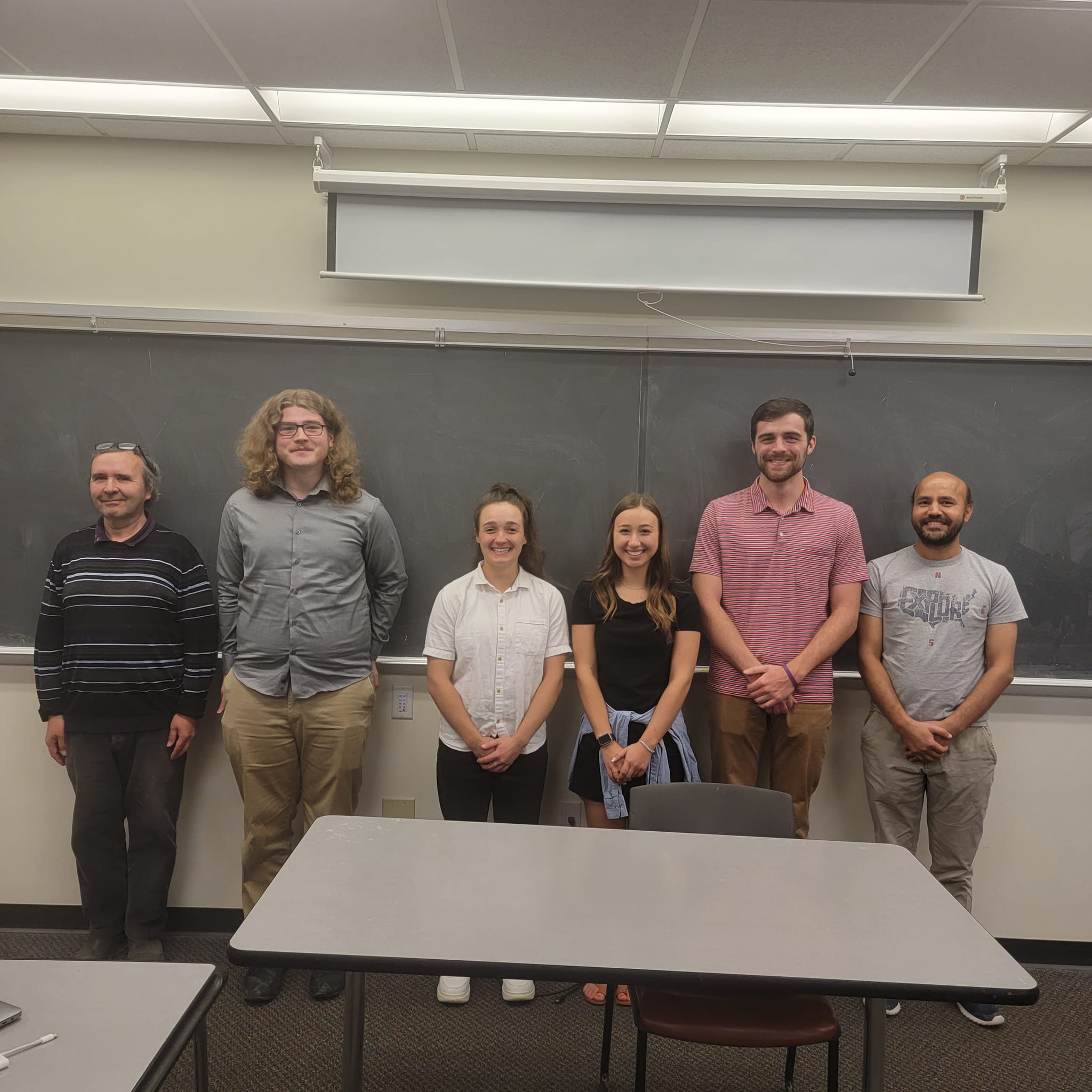
Senior Capstone presentations - May 10, 2023

Session of Senior Capstone presentations today at ONU, featuring topics on Partial Differential Equations and Number Theory. It was definitely a success, with a lively attendance. Many thanks to these awesome students!


Friday, December 16, 2022

Undergraduate research - a post pandemic restart

My first post-pandemic faculty-student paper and the 14-th overall (written with Rachael Harbaugh, ONU '23, a talented Mathematics Education major). Glad for this "restart". Students need confidence, need to be exposed to interesting math topics, and then we hope for the best in their future timelines.


Friday, December 9, 2022

Senior Capstone Colloquium - Fall 2022

Mathematics Capstone Colloquium - December 7, 2022 @ohionorthern (from L to R: Dr. Chowdhury, Joelena Brown, Rachael Harbaugh, and Dr. Caragiu)

Joelena Brown: "Rectangular Donut Numbers" (advisor Dr. Chowdhury)

Rachael Harbaugh: "Extending a Putnam Problem to Fields of Various Characteristics" (advisor Dr. Caragiu)


Thursday, August 5, 2021

My Top 100 book as a jazz of numbers

Sequential Experiments with Primes got into the 100 Best Number Theory Books of All Time @ https://bookauthority.org/books/best-number-theory-books As an undergraduate college faculty member, I am happy. Thank you! :-)

I believe the attractiveness of the book lies not only on the novelty of certain ideas, but also in the style in which said novelty is attained. It's a sort of "jazz" with numbers (unfolding as a sustained creative piece not unlike the free development of a jazz gig).  A jazz with no particular rigid/studied reverence to other established theoretical approaches. Just free self-sustained jazz discovering new facts. In its way, it's structured as a sort of "dessins d'enfants" leading to a different look on the mystery of prime numbers.


Monday, June 16, 2014

Joint Statistical Meetings Proceedings - not peer-reviewed

"If you give a presentation at JSM, you may submit a corresponding paper to be published in the conference proceedings. Papers are not peer-reviewed in the same manner as for journals, but authors are encouraged to have others examine their paper before submission. The proceedings are published online around November. Authors retain the right to publish their research later in a peer-reviewed journal."
SOURCE: "What Happens at JSM Should Not Stay at JSM / How to get the most out of the Joint Statistical Meetings"  AMSTAT News - May 2014
http://magazine.amstat.org/wp-content/uploads/2014/02/AN_May2014.pdf

Thursday, May 22, 2014

Eu si... Antonin Scalia

Pe o scara personal/academica, momentul cel mai interesant al anului care a trecut a survenit atunci cind am fost comparat (la o conferinta, deci in public) cu... Antonin Scalia (!). Intentia nu a fost magulitoare, iar motivul fiind inistenta mea pe cercetarea intreprinsa de profesori, (nici vorba de "publish or perish" la un 4 years college, insa macar "publish involving undergraduates" - pentru un 4 years college ar fi minunat). Insistenta mea a trezit reactii mixte: unii s-au bucurat ("it's about time!"), altii au subliniat ceva in genul "teaching is paramount" (so?... does this exclude engaging students in research?), altii au fost relativ ostili, negind orice rol special acordat publicatiilor cu sau fara studenti co-autori. In sfirsit, ma bucur ca macar aceasta atitudine i-a pus pe ginduri pe unii.

Sunday, September 29, 2013

Miami University Fall Conference on Undergraduate Research in Mathematics

Abstract of my presentation:

More than twelve years ago, a talk on "Ducci games" delivered jointly by two Ohio Northern University students at the 2001 Ohio MAA Spring meeting initiated a fairly long streak of undergraduate research in the area of number theory at our school. Since then, Ohio Northern University students presented 40 talks and posters in the broad area of number theory at various mathematics meetings, and were co-authors of 11 research articles in number theory which appeared in peer-reviewed mathematics journals. We were especially pleased to see our research on "greatest prime factor sequences" (published in Fibonacci Quarterly in 2010) featured alongside other "noteworthy variations on the Fibonacci numbers" in the keynote talk at the 15th International Conference on Fibonacci Numbers held in Budapest (June 25-30, 2012), and cited in various other journals. In the light of the speaker's experience as an undergraduate research advisor, we will try to address some issues of interest regarding the impact of undergraduate research in the outside mathematical community. This "impact" may be viewed as a long-sought fulfillment or closure of the combined efforts of faculty and students engaged in undergraduate research, which ultimately takes a life of its own. We will explore open-ended difficult questions such as: What does it mean to make an impact? Are there specific strategies for smaller schools? Can presentations make an impact? What is the relationship between undergraduate research and faculty research? Is it harder for pure mathematics?

Thursday, July 18, 2013

Monday, January 14, 2013

A Uniform Distribution Result for k-Paradoxical Directed Graphs

The research I am conducting with two students of mine was presented at the 2013 MAA Undergraduate Poster Session in San Diego.


Friday, October 19, 2012

The Role of Research at Undergraduate Institutions

An excellent article by Robert Gavin, in "Academic Excellence - The role of research in the physical sciences at undergraduate institutions" (Michael P. Doyle, Editor - published in the year 2000 by Research Corporation - a foundation for the advancement of science). Even if the paper, which emphasizes the role of publishing in a research-based education, refers to physical sciences, the ideas in there are even better suitable for mathematical sciences, where there is not an excessive need for laboratories and equipment.
Straight to the point: "Publishing research articles, especially those done in collaboration with undergraduate students, should be expected, encouraged and supported both before and after the tenure decision".

Tuesday, December 6, 2011

GPF sequences in Rutgers' Experimental Mathematics Seminar

Apparently the sequences introduced in the Fibonacci Quarterly paper by Greg Back and myself have been discussed in the RUTGERS EXPERIMENTAL MATHEMATICS SEMINAR (Neil J. A. Sloane's presentation was on February 17, 2011

Monday, May 23, 2011

Undergraduate research: what is that ?

The Council on Undergraduate Research defines it as follows:
``An inquiry or investigation conducted by an undergraduate student that makes an original intellectual or creative contribution to the discipline.''
The word "original" is very important. An original contribution to knowledge rules out works of a severely expository or textbook nature, results that follow immediately from previous work (as in... use the previously obtained A=B to "discover" that 2A=2B, or something like that), or trivial derivations in existent or made-up ad hoc formal systems. The original contribution to the discipline must also go through a rigorous, external, peer-review process. Ideally, a rigorous, solid peer-review is a process which does not accept works simply because they are formally correct, indeed it demonstrates a pattern of rejecting a significant percentage of logically correct but otherwise not interesting enough (as judged by the reviewers) works. Also, note that being "peer-reviewed" is not the same with "being made public/disseminated" (a confusion that is still circulating). A valuable original contribution will be able to generate 'participative waves', engaging others in the area. Thus, when it comes to goals and assessment, 'undergraduate research' is not (and shouldn't be, in my opinion) different from good old 'research'. So it is a serious matter, and competitive universities recognize that. I found interesting the following straight-to-the-point statement (due to Jim Coleman, vice chancellor for research and professor of biology at the University of Missouri) on the central place of undergraduate research in the life of a good university:
``There is nothing more central to the mission of a university than activities associated with discovery, creation, innovation and scholarship. So, I think that what defines a great university is the integration of these activities into the entire fabric of the undergraduate experience.''
Integrating the research/scholarship into the undergraduate life is a challenging enterprise. There are no clear recipes, since there are students and students. Each individual case is unique and interesting in itself. The faculty's essential asset is their own involvement and demonstrated proficiency in research. Indeed the undergraduate research is driven, after all, by faculty research. Or, if you want, faculty research is a necessary condition for undergraduate research. One may ask, is it also a sufficient condition? This is not true, mainly because the student is a person, not a machine or a notebook on which the faculty mentor writes a paper. In the end, note that the complexities of (undergraduate) research that even an otherwise well prepared academic (mentor) faces, ultimately point to persons (as in real persons, and not ``the idea of a person''), and their participative experience.