Terence Tao: Structure and Randomness in the Prime Numbers, UCLA
Slides: pdf, powerpoint
Lecture for a general audience: Terence Tao is UCLA's Collins Professor of Mathematics, and the first UCLA professor to win the prestigious Fields Medal.

Friday, July 30, 2010
Tuesday, July 27, 2010
Johann Bernoulli (1667 - 1748) anniversary
Johann Bernoulli (1667 - 1748) was born on July 27, 7^3 years ago, in Basel, Switzerland. He was Euler's "mathematical parent".
And here is the... "sophomore's dream" - neat identities due to Johann Bernoulli (1697):

And here is the... "sophomore's dream" - neat identities due to Johann Bernoulli (1697):
Wednesday, July 21, 2010
A traffic flow simulation
This traffic flow educational project with Matlab features a gradually increasing car density starting from an initial value of 0.2. There are 250 cells. The update rule (describing the transition from time t to time t + 1): apply rule 184, after which randomly select a position - if occupied, nothing happens, while if empty, introduce a car at the selected place with probability 0.7. The image follows the first 500 time units. Notice the transition to a congested regime happening at some point (emerging shock waves). In the picture, free cells are blue, while cells occupied by "cars" are red.

Tuesday, July 6, 2010
Lothar Collatz anniversary

Lothar Collatz, who proposed (in 1937) the celebrated "3n+1 problem", was born 100 years ago in Arnsberg, Germany.
Mac Tutor Biography
Lothar Collatz at MGP
Saturday, June 5, 2010
A Thermodynamic Classification of Real Numbers
I just found a very interesting paper presentation (JNT on YT - link) by Thomas Garrity (Williams College) - "A Thermodynamic Classification of Real Numbers":
On arXiv - A Thermodynamic Classification of Real Numbers.
On arXiv - A Thermodynamic Classification of Real Numbers.
Wednesday, May 5, 2010
Élie Cartan (1869-1951)
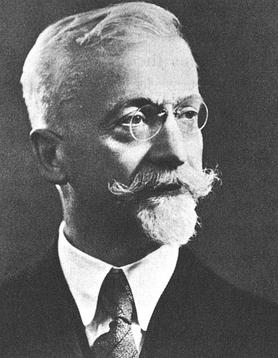
Élie Cartan had significant contributions in areas such as Lie theory, differential geometry, exterior differential forms, the theory of spinors (introduced by him in 1913), etc. Cartan died on May 6, 1951.
Dieudonné places Cartan right after Poincaré and Hilbert when it comes to the lasting influence in shaping modern mathematics. He was a speaker at the 1924, 1932 and 1936 International Mathematical Congresses. He lectured in Romania in 1931. The letters that he exchanged with Albert Einstein, Gheorghe Ţiţeica, Alexandru Pantazi and Gheorghe Vrânceanu, have been published (as mentioned in M. A. Akivis and B Rosenfeld - Élie Cartan (1869-1951), Providence R.I., 1993).
Thursday, April 29, 2010
Paul Montel (1876-1975)
Paul Antoine Aristide Montel, Honorary Member of the Romanian Academy, advisor of Henri Cartan, Jean Dieudonné, Miron Nicolescu, Tiberiu Popoviciu and others (see Montel's entry at MGP), was born on April 29, 1876...
Saturday, April 24, 2010
Max Planck on consciousness
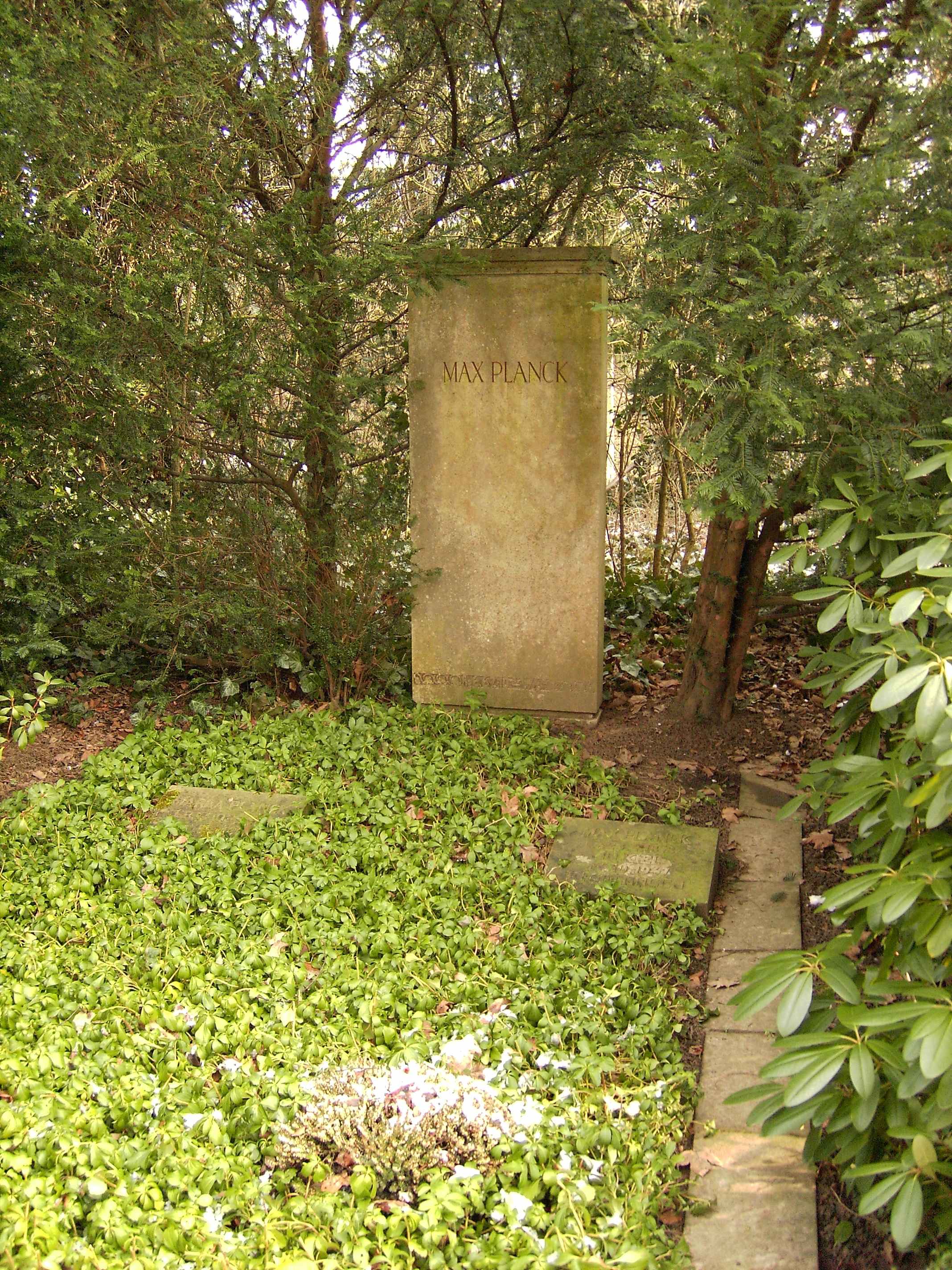
link to quotation source
link to top picture source/credits (grave of Max Planck in Göttingen)

link to bottom picture source/credits (NGC7090)

Mac Tutor Biography
Mathematics Genealogy Project - Max Planck
Planck units

Thursday, April 22, 2010
Marius Dabija (13 ianuarie 1969-22 iunie 2003)

Un prieten căruia îi păstrez o vie amintire este Marius Dabija. Minte strălucită, scormonitoare, imprevizibil in acţiuni, căutând mereu soluţia surpriză. În clasele a VII-a şi a VIII-a am lucrat împreună la matematică, pregătindu-ne pentru Olimpiade. Ca să variem, jucam şah până nu mai ştiam de noi. Era talentat şi la fotbal, tenis de masă etc.
În liceu ne-am văzut mai rar. Eu eram la liceul I. L. Caragiale, el, la Mihai Viteazul. L-a avut profesor pe Eugen Onofraş. În clasa a XI-a, Marius a luat locul I la Olimpiada de matematică, faza Naţională şi la Olimpiada Internaţională de Matematică. După ce a absolvit Facultatea de matematică, a plecat la doctorat în America, unde munca de cercetare i-a fost încununată de reuşită. A luat doctoratul şi a scos nişte articole remarcabile.
Ca elev şi student, era în stare să-şi conducă profesorii de la agonie la extaz şi invers. Născocea pe loc soluţii din cele mai diverse la câte o problemă, după care, lăudat fiind de profesor, care nu reuşea totuşi să urmărească deplin şirul argumentărilor, revenea şi arătând că greşise într-un loc ştergea totul, scoţând ca din joben o altă demonstraţie fulger. Asta se putea întâmpla de câteva ori la rând...
Avea de regulă o deosebită poftă de viaţă, umor, voioşie, neastâmpăr, o doză sensibilă de nonconformism, atras de situaţii-limită, uneori fiind, e drept chinuit de gânduri şi întrebări, incertitudini existenţiale, întorcând lucrurile pe toate părţile în căutarea unei soluţii, construind şi deconstruind la nesfârşit.
Mie îmi părea câteodată, în unele momente ale sale de graţie, că regăsesc profilul unui Mozart al matematicii. Am aflat cu durere în inimă vestea că în America a trecut pe neaşteptate la cele veşnice, în plină activitate creatoare, la numai 34 de ani. Dumnezeu să-l ierte şi să-l odihnească!
Articole Publicate:
Dabija, M. "Algebraic and Geometric Dynamics in Several Complex Variables". PhD thesis, University of Michigan, 2000. ps.gz
Bonifant, A. and Dabija, M. "Contractive Curves". International Journal of Mathematics and Mathematical Sciences, 30(4), 2002. ps.gz
Bonifant, A. and Dabija,M. "Self-maps of P2 with invariant elliptic curves". Contemporary Mathematics, 311, 2002. ps.gz
Coman,D.and Dabija, M. "On the Dynamics of Some Diffeomorphisms of C2 near parabolic fixed points". Houston Journal of Mathematics, 24(1), 1998. pdf
Articole Nepublicate:
Dabija, M. "Bötcher divisors", 2000. ps
Dabija,M. "Self-maps of projective bundles on projective spaces",2000. ps
Dabija, M."Self-maps of ruled surfaces", 2000. ps
Dabija,M.and Jonsson, M. "Self-maps of P2 with an invariant curve of curves", 2002.
Wednesday, February 24, 2010
Tuesday, February 16, 2010
Ph.D. mathematician and NFL champion
In some sense, the stunning 2010 Super Bowl XLIV victory of New Orleans Saints led by Drew Brees against the Peyton Manning's Indianapolis Colts (my favorite team) may be analogue to a similar event that happened in 1964. Then the NFL quarterback Frank Ryan led the Cleveland Browns to the 1964 NFL Championship title in a 27-0 victory against Johnny Unitas' Baltimore Colts. To this one might add the impressive 1966 season in which the Cleveland Browns' legend Ryan threw for 2974 yards and scored 29 touchdowns.
What is especially relevant for this particular blog is that Frank Ryan is also the recipient of a Ph.D. in Mathematics awarded by Rice University in 1965, with a most interesting thesis, "A Characterization of the Set of Asymptotic Values of a Function Holomorphic in the Unit Disc", and that among the references cited in the thesis are Luzin's "Leçons sur les ensembles analytiques et leurs applications", Sierpinski's "General Topology" (University of Toronto Press, 1952), and Stoilow's "Les propriétés topologiques des fonctions analytiques d'une variable", Ann. Inst. H. Poincaré, 2 (1932), 233–266. In 1966 Frank Ryan also published two fundamental papers on the set of asymptotic values of a function holomorphic in the unit disc in Duke Mathematical Journal (he also published in Pacific Journal of Mathematics, Mathematische Zeitschrift, Michigan Mathematical Journal, etc).
I will conclude with mentioning a recent mathematical event - the amazing, super-entertaining after-dinner talk "Resolved, that a Football is a Mathematical Object" delivered by Frank Ryan at the 2007 Ohio MAA Meeting held at Wittenberg (a talk which I will never forget).
What is especially relevant for this particular blog is that Frank Ryan is also the recipient of a Ph.D. in Mathematics awarded by Rice University in 1965, with a most interesting thesis, "A Characterization of the Set of Asymptotic Values of a Function Holomorphic in the Unit Disc", and that among the references cited in the thesis are Luzin's "Leçons sur les ensembles analytiques et leurs applications", Sierpinski's "General Topology" (University of Toronto Press, 1952), and Stoilow's "Les propriétés topologiques des fonctions analytiques d'une variable", Ann. Inst. H. Poincaré, 2 (1932), 233–266. In 1966 Frank Ryan also published two fundamental papers on the set of asymptotic values of a function holomorphic in the unit disc in Duke Mathematical Journal (he also published in Pacific Journal of Mathematics, Mathematische Zeitschrift, Michigan Mathematical Journal, etc).
I will conclude with mentioning a recent mathematical event - the amazing, super-entertaining after-dinner talk "Resolved, that a Football is a Mathematical Object" delivered by Frank Ryan at the 2007 Ohio MAA Meeting held at Wittenberg (a talk which I will never forget).
Monday, November 23, 2009
Fibonacci numbers and the extreme and mean ratio - some history
Ruth Tatlow's article The Use and Abuse of Fibonacci Numbers and the Golden Section in Musicology Today (Understanding Bach, 1, 69-85, 2006) besides being very interesting in itself as a documented criticism of the "Golden numberism [that] has thoroughly infected musicology", incidentally provides useful references for those interested in the history of the representation of the EMR ("extreme and mean ratio" or "golden section") as the limit of the sequence of quotients Fn+1/Fn of consecutive Fibonacci numbers [1]. One may wonder who noticed this first? Leonardo Pisano (c. 1170 – c. 1250, also known as Fibonacci)? Not even close!
Evidence that this fact was noticed as early as the beginning of the 16th century was discovered by Leonard Curchin and Roger Herz-Fischler (handwritten annotation in the 1509 Luca Pacioli's edition of Elements [2]). When it comes to published work which associates the EMR with the limit of the sequence of quotients of consecutive Fibonacci numbers, Johannes Kepler wrote [3] the following, in 1611, about "this proportion that the geometers of today call divine":
NOTES
[1] The term "extreme and mean ratio" goes back to Euclid's "Elements". Luca Pacioli introduced the "divine proportion" term in 1509, while the term "golden section" was introduced in 1835 by Martin Ohm. The exact value for the EMR is (1+sqrt(5))/2. The phrase "Fibonacci sequence" was coined by Edouard Lucas (1842-1891).
[2] Leonard Curchin and Roger Herz-Fischler, "De quand date le premier rapprochement entre la suite de Fibonacci et la division en extrême et moyenne raison?" (French) ["When were the first parallels drawn between the Fibonacci sequence and the golden section?"], Centaurus 28 (1985), no. 2, 129-138.
[3] Kepler, Johannes. Vom sechseckigen Schnee. (German) [On hexagonal snowflakes]. Translated from the Latin and with an introduction and notes by Dorothea Goetz. Ostwald's Classics of the Exact Sciences, 273. Akademische Verlagsgesellschaft Geest & Portig K.-G., Leipzig, 1987.
[4] Peter Schreiber, "A Supplement to J. Shallit’s Paper "Origins of the analysis of the Euclidean algorithm"", Historia Mathematica, Vol. 22, Issue 4, 422-424 (1995). http://poncelet.math.nthu.edu.tw/disk5/js/history/1033a.pdf
Evidence that this fact was noticed as early as the beginning of the 16th century was discovered by Leonard Curchin and Roger Herz-Fischler (handwritten annotation in the 1509 Luca Pacioli's edition of Elements [2]). When it comes to published work which associates the EMR with the limit of the sequence of quotients of consecutive Fibonacci numbers, Johannes Kepler wrote [3] the following, in 1611, about "this proportion that the geometers of today call divine":
It is impossible to provide a perfect example in round numbers. However, the further we advance from the number one, the more perfect the example becomes. Let the smallest numbers be 1 and 1... Add them, and the sum will be 2; add to this the greater of the 1s, result 3; add 2 to this, and get 5; add 3, get 8; 5 to 8, 13; 8 to 13, 21. As 5 is to 8, so 8 is to 13 approximately, and as 8 to 13, so 13 is to 21, approximately.However, as communicated in 1995 by Peter Schreiber [4], in a rare book by the German reckoning master Simon Jacob (d. 1564) one can find a remark that the sequence of quotients of consecutive Fibonacci numbers approaches the EMR.
NOTES
[1] The term "extreme and mean ratio" goes back to Euclid's "Elements". Luca Pacioli introduced the "divine proportion" term in 1509, while the term "golden section" was introduced in 1835 by Martin Ohm. The exact value for the EMR is (1+sqrt(5))/2. The phrase "Fibonacci sequence" was coined by Edouard Lucas (1842-1891).
[2] Leonard Curchin and Roger Herz-Fischler, "De quand date le premier rapprochement entre la suite de Fibonacci et la division en extrême et moyenne raison?" (French) ["When were the first parallels drawn between the Fibonacci sequence and the golden section?"], Centaurus 28 (1985), no. 2, 129-138.
[3] Kepler, Johannes. Vom sechseckigen Schnee. (German) [On hexagonal snowflakes]. Translated from the Latin and with an introduction and notes by Dorothea Goetz. Ostwald's Classics of the Exact Sciences, 273. Akademische Verlagsgesellschaft Geest & Portig K.-G., Leipzig, 1987.
[4] Peter Schreiber, "A Supplement to J. Shallit’s Paper "Origins of the analysis of the Euclidean algorithm"", Historia Mathematica, Vol. 22, Issue 4, 422-424 (1995). http://poncelet.math.nthu.edu.tw/disk5/js/history/1033a.pdf
Friday, September 18, 2009
Bernhard Riemann
Georg Friedrich Bernhard Riemann (September 17, 1826 – July 20, 1866) - one of the greatest mathematicians of all time.
- Full Mac Tutor Biography
- Wikipedia entry
- The Mathematical Papers
- Mathematics Genealogy
- "On the Number of Primes Less Than a Given Magnitude" (pdf)
Here rests in God
Georg Friedrich Bernhard Riemann
Professor in Göttingen
born in Breselenz, September 17th, 1826
died in Selasca, Juli 20th, 1866
---
Those, who love God, all things
must serve to its best manner.
Friday, February 20, 2009
Fibonacci modulo m
The general problem of the periods of the Fibonacci sequence modulo m is definitely non-trivial (with the case m = p - prime - playing a very important role). An important reference can be found here ("The Fibonacci Sequence Under Various Moduli" - M.Sc. Thesis by Marc Renault, 1996). Also see the article (PDF) "The Fibonacci sequence modulo p^2...".
An example that teachers use relatively often as a middle-school problem: "Find the period of the sequence of the last digits of the Fibonacci numbers"! That will correspond to the modulus m=10, the answer is 60, and the elements of the period are
An example that teachers use relatively often as a middle-school problem: "Find the period of the sequence of the last digits of the Fibonacci numbers"! That will correspond to the modulus m=10, the answer is 60, and the elements of the period are
0,1,1,2,3,5,8,3,1,4,5,9,4,3,7,0,7,7,4,1,5,6,1,7,8,5,3,8,1,9,0,If the modulus m is 2011 (that is the 305-th prime), the period of the Fibonacci sequence modulo m is 2010.
9,9,8,7,5,2,7,9,6,5,1,6,7,3,0,3,3,6,9,5,4,9,3,2 ,5,7,2,9,1
Subscribe to:
Comments (Atom)